
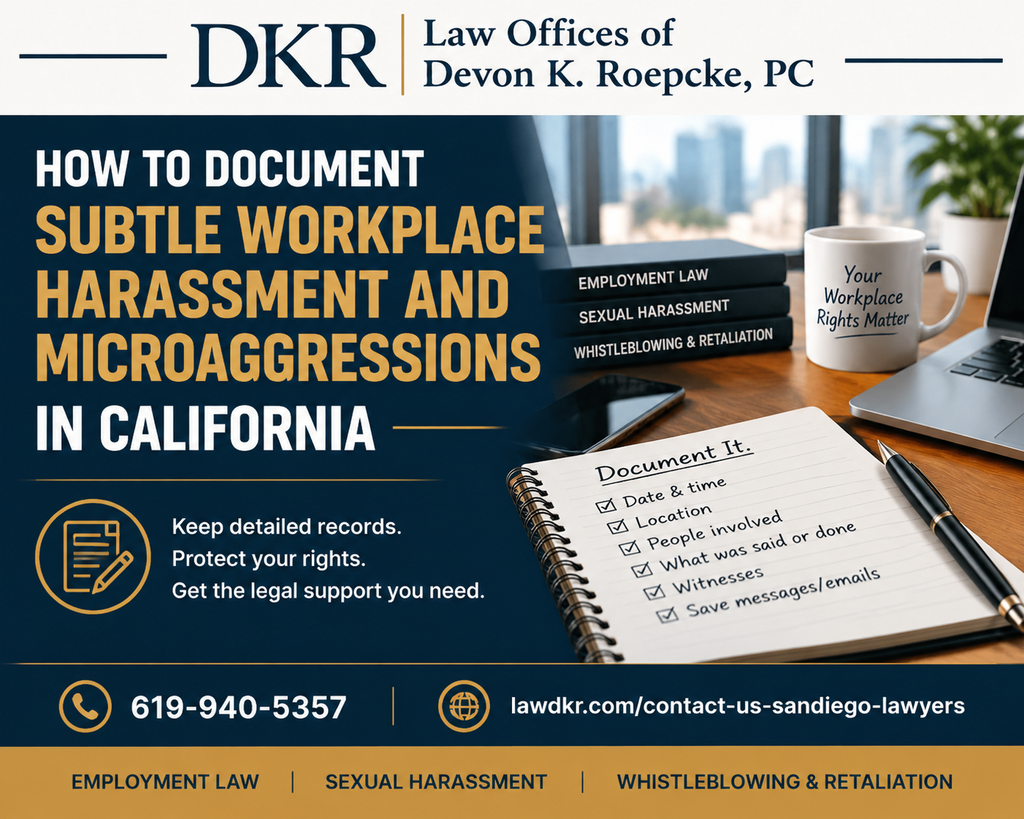
Understanding Your Rights When Workplace Harassment Is Difficult to Prove
Workplace harassment is not always obvious. While some forms of harassment involve direct threats, offensive comments, or clear discriminatory behavior, many employees experience more subtle conduct that builds over time.
Repeated comments, inappropriate jokes, exclusion from workplace opportunities, unfair treatment, or ongoing microaggressions can create a hostile and uncomfortable work environment. However, because these actions may appear minor when viewed individually, documenting them properly is critical.
If you believe you are experiencing harassment at work, keeping detailed records can help protect your rights and provide important evidence if you need to pursue a legal claim.
The Law Offices of Devon Roepcke helps employees throughout San Diego and California understand their workplace rights and take action when they experience unlawful harassment, discrimination, retaliation, or other employment issues. To discuss your situation, contact our office at 619-940-5357 or visit our contact page.
What Are Workplace Microaggressions?
Microaggressions are subtle comments, behaviors, or actions that communicate negative or disrespectful messages toward someone because of a protected characteristic, such as:
- Race or ethnicity
- Gender or sex
- Sexual orientation
- Disability
- Age
- Religion
- National origin
- Other protected categories under California employment laws
Unlike obvious harassment, microaggressions are often disguised as jokes, compliments, assumptions, or casual remarks.
Examples may include:
- Repeatedly questioning an employee’s qualifications because of their gender or background
- Making comments about someone’s accent or cultural background
- Assuming someone cannot perform certain tasks because of their age or disability
- Making inappropriate comments about appearance or personal characteristics
- Excluding certain employees from meetings, projects, promotions, or opportunities
One isolated comment may not always meet the legal standard for harassment. However, a repeated pattern of unwanted conduct may contribute to a hostile work environment, especially when the behavior is severe or pervasive.
If you are experiencing ongoing harassment, speaking with a San Diego employment law attorney can help you understand your options and determine what steps to take next.
Why Documenting Workplace Harassment Matters
Many employees hesitate to report subtle harassment because they worry they do not have enough evidence. However, detailed documentation can make a significant difference.
Workplace harassment cases often depend on proving:
- What happened
- When it happened
- Who was involved
- Whether the behavior was repeated
- How the employer responded after learning about the conduct
A detailed record can help establish a timeline and demonstrate patterns of inappropriate workplace behavior.
How to Document Workplace Harassment in California
1. Keep a Private Harassment Log
Start documenting incidents as soon as you notice a pattern of concerning behavior.
Your documentation should include:
- The date and time of each incident
- Where the incident occurred
- The names of everyone involved
- The names of witnesses who were present
- The exact words or actions that occurred
- How you responded
- Any follow-up conversations or reports made
Whenever possible, write down exact statements using quotation marks instead of summarizing what happened.
For example:
Instead of writing:
“Manager made a discriminatory comment.”
Write:
“On September 1, 2026, during the team meeting, my supervisor stated, ‘[exact statement].’ Employees present included [names].”
Specific details are much more valuable than general descriptions.
2. Preserve Emails, Messages, and Other Evidence
Digital evidence can be extremely important in workplace harassment cases.
Save copies of:
- Emails
- Text messages
- Workplace chat messages
- Performance reviews
- Schedule changes
- Written warnings
- Policy documents
- Relevant workplace communications
Do not edit screenshots or remove information from conversations. Preserve messages in their original format whenever possible.
If you are concerned that your employer may remove access to workplace systems, save important information appropriately and speak with an employment law attorney before taking further action.
The Law Offices of Devon Roepcke can help employees understand what evidence may be important when evaluating a workplace harassment claim.
3. Report Harassment Following Workplace Procedures
If you decide to report harassment, follow your employer’s reporting process whenever possible.
Your complaint should clearly explain:
- What occurred
- When it happened
- Who was involved
- Whether the behavior has continued
- What action you are requesting
Submit your complaint in writing and keep a copy for your records.
A written complaint creates documentation that your employer was informed of the problem.
4. Watch for Workplace Retaliation
Employees are protected from retaliation when they report harassment or participate in workplace investigations.
Retaliation may include:
- Sudden negative performance reviews
- Reduced hours or responsibilities
- Exclusion from workplace opportunities
- Demotion
- Termination
- Increased hostility after making a complaint
If you experience retaliation after reporting harassment, document those actions immediately.
California employees may have separate legal protections when employers retaliate against them for reporting unlawful workplace conduct.
5. Avoid Confronting the Situation Without Understanding Your Rights
Many employees want to immediately confront the person responsible for harassment. However, depending on the circumstances, this may create additional challenges.
Before taking significant action, consider speaking with an experienced employment law attorney who can review your situation and explain your options.
The Law Offices of Devon Roepcke provides guidance to employees dealing with harassment, discrimination, retaliation, and other workplace disputes throughout San Diego and California.
Call 619-940-5357 or visit our contact page to discuss your situation.
When Should You Contact a Workplace Harassment Attorney in San Diego?
You should consider speaking with an employment law attorney if:
- You believe harassment is based on a protected characteristic
- Your employer ignored your complaint
- The harassment continued after reporting it
- You experienced retaliation
- You are unsure whether your situation qualifies as unlawful harassment
- You need help preserving evidence
An attorney can help evaluate your documentation, explain your legal options, and help protect your rights.
Frequently Asked Questions About Documenting Workplace Harassment
How do I prove workplace harassment in California?
Proving workplace harassment often requires evidence showing what happened, when it occurred, who was involved, and whether the behavior was severe or repeated. Documentation such as emails, messages, witness statements, and personal notes can help establish a pattern of harassment.
Should I document harassment even if I am unsure it is illegal?
Yes. Keeping detailed records can help you understand whether the behavior may violate workplace laws and provides important information if you later decide to report the conduct or speak with an attorney.
What evidence is helpful in a workplace harassment claim?
Helpful evidence may include:
- Emails and text messages
- Workplace chat records
- Written complaints
- Witness information
- Performance reviews
- Notes documenting incidents
- Employer responses to complaints
Can my employer fire me for reporting harassment?
No. California employees are generally protected from retaliation for reporting workplace harassment or participating in workplace investigations. If an employer takes negative action after a complaint, you may have a separate retaliation claim.
What is considered sexual harassment at work in California?
Sexual harassment may include unwanted sexual comments, advances, requests for sexual favors, inappropriate touching, or other conduct based on sex that creates a hostile work environment.
If you are experiencing this type of behavior, the Law Offices of Devon Roepcke helps employees address sexual harassment concerns in San Diego and throughout California.
How long do I have to report workplace harassment in California?
Deadlines for workplace harassment claims can vary depending on the circumstances and the type of claim. Speaking with an employment law attorney as soon as possible can help ensure important deadlines are not missed.
Contact the Law Offices of Devon Roepcke About Workplace Harassment in San Diego
If you are experiencing workplace harassment, discrimination, retaliation, or another employment-related issue, documenting what happened is one of the most important steps you can take.
The Law Offices of Devon Roepcke helps employees throughout San Diego and California understand their rights and explore their legal options.
Our office is located at:
Law Offices of Devon Roepcke
7290 Navajo Road, Suite 106
San Diego, CA 92119-1631
Call 619-940-5357 or visit our contact page to schedule a consultation.
Your workplace concerns deserve to be taken seriously. Proper documentation today can help protect your rights tomorrow.
Connect with us


